

On the one hand, we buy to solve an identified problem, armed with a strict set of specifications. On the other hand, we’re drawn in by a technological offering or an interface so seamless that it creates a need that didn’t originally exist. This is the famous “wow effect.” But how do these two dynamics actually balance out when it comes time to choose a solution?
Reason vs. Emotion in SaaS Purchases
When analyzing the drivers behind B2B solution purchases, the balance has historically tilted toward rationality, but the capacity for innovation is becoming increasingly important:
- 70 to 75% of software choices are “demand-driven.” The company faces an operational challenge (a need for security, sovereignty, compliance, integration, environmental responsibility, etc.) and seeks a tool that will meticulously check all the boxes in its requirements specification.
- Conversely, 25 to 30% of investments are “supply-driven.” It is the discovery of a transformative feature or an exceptional interface during a demonstration that triggers the purchase. Innovation then sparks a desire to evolve, and the budget is allocated for a technology that was not initially planned.
When the Specifications Set the Rules: Standard Requirements
In most cases, the search for an enterprise video solution (such as Streamlike) begins with non-negotiable technical requirements. The client knows what they want, and the solution must strictly comply with those requirements.
These “standard” requirements often include:
- Data sovereignty and security: European hosting, IP-based access restrictions, or Single Sign-On (SSO) integration. The need is clear and straightforward: internal or sensitive communications must not be leaked.
- Integration with the Information System: The need for robust APIs to seamlessly connect video to the company’s CRM, intranet, or LMS (Learning Management System).
- Accessibility: Native modules for subtitling, multilingual support, and strict compliance with digital accessibility standards (RGAA).
- Internal network reliability: The ability to stream a live event to thousands of employees simultaneously without overwhelming the bandwidth.
There’s no room for improvisation here: the platform is chosen for its robustness, reliability, and compliance.
When the offering sparks desire: Inspiration and the “Wow” factor
Conversely, there are times when a company comes to us for a simple, standard hosting solution and leaves with a plan to transform its communications. This is where inspiration comes into play. An original technical proposal can awaken an unexpected ambition in the client.
Here’s what sparks that inspiration in today’s video market:
- Artificial Intelligence for User Experience: Automatic transcription and translation, simultaneous translation of live broadcasts, smart chaptering, indexing, and the generation of summaries, quizzes, or FAQs. Users discover ways to create a truly engaging experience around their content, with a speed and at a cost that human operators cannot match.
- Interactivity and Engagement: Discovering that a simple training video can be transformed into an immersive experience (a “branching” video where the viewer chooses the next part of the story, or clickable on-screen elements) changes the project manager’s perspective.
- Eco-design and carbon measurement: Five years ago, no one would have included “video carbon footprint” in a set of specifications. Today, discovering a dashboard that measures the greenhouse gas footprint of their video streams is a real eye-opener. The tool no longer merely streams content; it inspires a commitment to digital frugality and helps the company achieve its CSR goals.
- A premium, invisible player: A user interface that breaks away from the market’s rigid standards (often modeled after social media platforms) to blend seamlessly into the brand’s DNA, delivering a “wow factor” through its purity and fluidity.
Innovation and Creativity
The element of surprise and uniqueness in an offering—which can generate particular interest—sometimes stems from very simple ideas that provide an original experience. For example:
- browsing a video catalog using a mind map-style interface
- a geographic interface that displays videos where they were filmed,
- synchronizing videos with a GPS track
- a mobile interface that incorporates social media features for a corporate media library, allowing users to “swipe” through videos, “like” them, comment on them, and more.
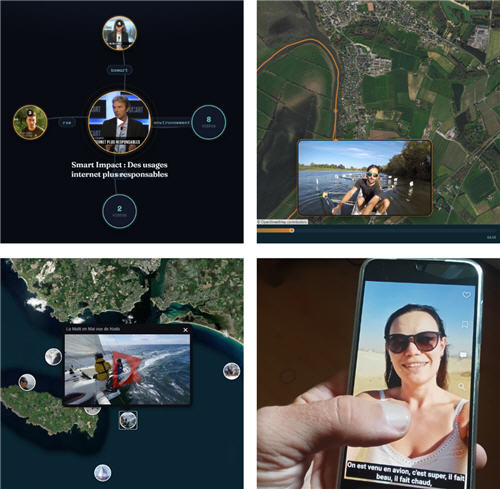
These projects—and many others—aren’t listed in a catalog because they don’t meet standard needs. They’re offered on demand and are often custom-developed or configured.
To be surprised, sometimes you just have to walk through the door 😉
The ideal balance?
A sustainable solution cannot rely solely on demo gadgets, just as it cannot be limited to a list of features. The best video platforms are those that strike the perfect balance: offering the robustness of an infrastructure that meets the strictest specifications, while cultivating the ability to inspire and anticipate the uses of tomorrow.